Affiliate marketing vs dropshipping: Which one is more profitable?
Mar 10, 2026
/
Larassatti D.
/
7 min Read
Affiliate marketing enables you to earn commissions by promoting other companies’ products through unique tracking links, whereas dropshipping involves selling products directly from suppliers through your own online store.
Both models let you start an online business without purchasing inventory upfront, but they differ significantly in profitability, startup complexity, and long-term earning potential.
Affiliate marketing requires minimal setup and no customer service responsibilities, making it faster to launch. However, you earn only commissions on sales – typically a percentage set by the merchant.
Dropshipping demands more upfront work to build your store and manage operations, but gives you control over pricing and profit margins. This creates higher earning potential per sale and the opportunity to build customer relationships for repeat business.
Affiliate marketing vs dropshipping: What are the key differences?
Affiliate marketing refers to promoting other business brands to help them generate more revenue, while a dropshipping business allows you to sell another company’s products under your own brand name.
Another main difference between affiliate marketing and dropshipping lies in the payment process – while affiliate marketers are paid based on a commission rate, dropshippers earn money directly from their customers.
That said, the two also share a few similarities:
- Low startup costs
- No need to store inventory or ship the goods yourself
- Relatively low-risk business models
How does affiliate marketing work?
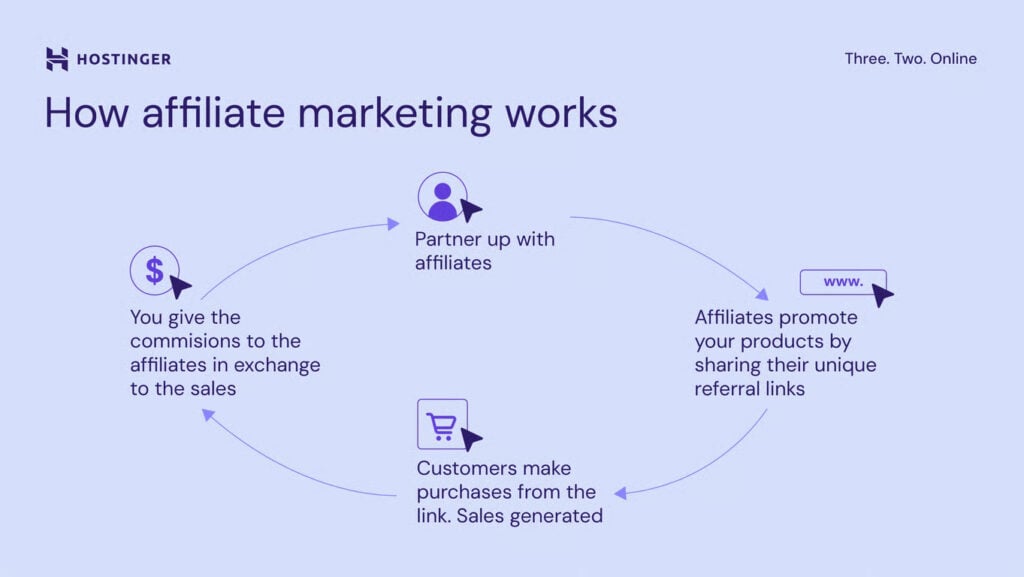
Affiliate marketing works through a partnership between an affiliate, a merchant, and customers.
An affiliate promotes the merchant’s products using a unique tracking link, earns commissions when customers make purchases through their link, and gets paid based on the program’s terms.
Starting an affiliate marketing business involves four key steps:
- Join an affiliate program and receive a unique affiliate link that tracks customer activity.
- Share the link with your audience through content like blog posts, social media, or email newsletters.
- Customers click on your link and complete a purchase on the merchant’s website.
- Earn a commission for each successful transaction – typically a percentage of the sale price or a fixed amount per conversion.
How does dropshipping work?
Dropshipping works by connecting a store owner, suppliers, and customers in a three-party fulfillment model.
To become a dropshipper, connect with a supplier and then list products on your online store. Once customers purchase from your site, forward orders to suppliers who ship directly to customers, and keep the profit margin between your retail price and the supplier’s wholesale cost.
Dropshipping eliminates traditional retail barriers by removing inventory investment requirements and warehouse space costs. This model allows you to test products and markets with minimal financial risks.
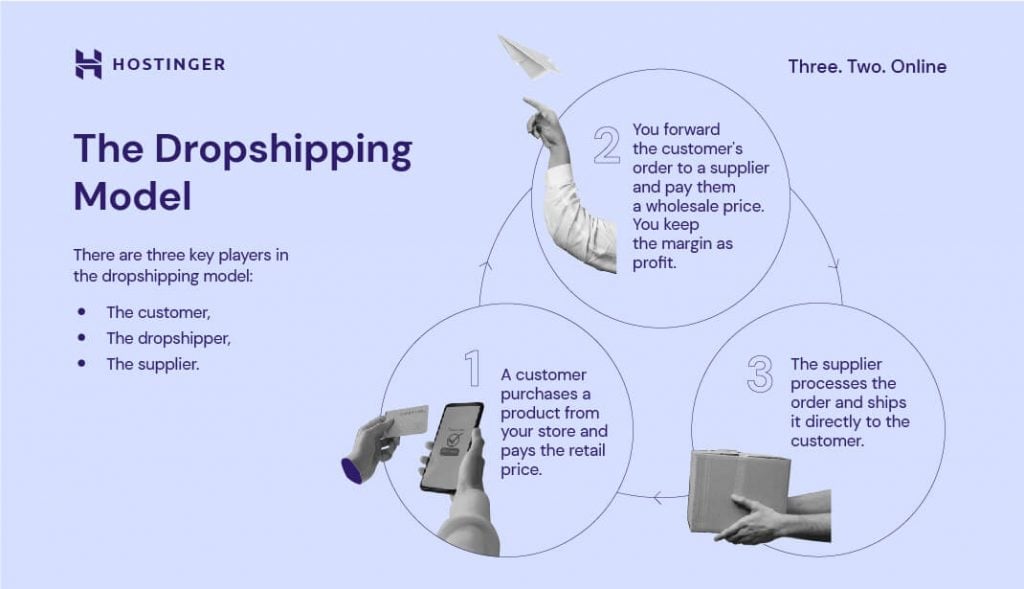
These are the five operational steps to start a dropshipping business:
- Create an online store and list products from supplier catalogs with your own pricing.
- Receive customer orders through your website and collect payment at your set retail price.
- Forward order details to your supplier and pay the wholesale cost per item.
- Supplier ships directly to your customer from their warehouse or facility.
- Keep the profit margin – the difference between your retail price and the supplier’s wholesale cost.
What are the advantages of affiliate marketing over dropshipping?
The primary advantages of affiliate marketing over dropshipping are the elimination of product handling responsibilities, reduced customer service requirements, faster business setup, and lower operational complexity.
- No fulfillment responsibilities. The merchant manages all inventory, packaging, and logistics for delivery. This eliminates fulfillment headaches and lets you focus entirely on content creation and promotion.
- No customer service burden. The merchant handles all customer inquiries, returns, refunds, and complaints. You’re not responsible for product quality issues, shipping delays, or dissatisfied customers, which significantly reduces your workload and stress.
- Lower startup costs. Starting a simple blog, building a social media presence, or creating YouTube videos is enough to start earning commissions as there’s no need for a full-fledged ecommerce website.
- Instant product catalog. You can promote thousands of products immediately without negotiating with suppliers or setting up integrations. Simply sign up for one of the affiliate marketing programs and start sharing links within minutes.
- Predictable commission structure. You know precisely what you’ll earn per sale upfront. The merchant handles pricing strategies and profit margin calculations, removing the guesswork from your revenue planning.
- Multiple merchant partnerships. You can promote products from dozens of different merchants simultaneously without coordinating multiple supplier relationships. This diversifies your income streams and reduces dependency on any single partner.
What are the disadvantages of affiliate marketing over dropshipping?
The disadvantages of affiliate marketing compared to dropshipping are lower profit potential per sale, zero control over pricing and margins, no ability to build a distinct brand, and complete dependency on merchant policies.
- Lower earnings per transaction. Affiliate commission rates typically range from 3-10% of the sale price, whereas dropshipping margins often reach 30-50%.
- No pricing control. You can’t adjust product prices to increase your profit margins. The merchant sets the price and your commission percentage, leaving you with no ability to optimize your earnings per sale.
- No customer ownership. You drive traffic to the merchant’s website, where they capture the customer relationship. Unless you’re building an audience through a blog or a YouTube channel, it’s hard to encourage repeat purchases or create long-term customer value.
- Vulnerable to program changes. Merchants can reduce commission rates, modify program terms, or terminate their affiliate program at any time. A policy change can instantly cut your income from a particular source.
- Limited differentiation. Hundreds of other affiliates may be promoting the same products with the same links. You’re competing purely on traffic generation and content quality, not on unique value propositions or customer experience.
- Dependent on merchant reputation. If the merchant delivers poor products, provides bad customer service, or goes out of business, your audience loses trust in your recommendations. You have no control over the quality that affects your credibility.
What are the advantages of dropshipping over affiliate marketing?
The advantages of dropshipping over affiliate marketing are higher profit margins, complete control over pricing strategy, the ability to build a distinct brand, and ownership of customer relationships.
- Higher profit potential. Setting your own product prices allows you to retain the full margin between wholesale and retail.
- Customer relationship ownership. Customers buy from the online store that you built, not from a third party. You can capture email addresses, purchase histories, and the opportunity to encourage repeat purchases, which builds long-term business value.
- Your own brand identity. Building a unique brand, from website design to product descriptions and customer service tone, differentiates your store from competitors and justifies premium pricing.
- Customer journey control. Deciding how products are presented, what upsells to offer, and how the checkout process works lets you optimize conversion rates and average order values.
- Revenue diversification. Selling products from multiple suppliers in one store creates diverse revenue streams. Unlike affiliates promoting scattered merchant sites, you consolidate everything under one brand.
What are the disadvantages of dropshipping over affiliate marketing?
The main disadvantages of dropshipping versus affiliate marketing are full responsibility for customer service, complex operational logistics, higher risk exposure, and significantly more time invested in business operations.
- Full customer service burden. You handle all inquiries, complaints, returns, and refunds. If a supplier ships a defective product or misses a delivery deadline, you may face angry customers and negative reviews, even though you don’t control the fulfillment process.
- Complex supplier coordination. Managing multiple supplier relationships, varying shipping times, and inconsistent product quality requires constant attention. An order with items from three different suppliers means coordinating three separate shipments with different arrival dates.
- Financial risk exposure. You need to invest in website infrastructure, payment processing, marketing campaigns, and potentially inventory samples. Unlike affiliates who risk only time and content creation costs, dropshippers face real financial loss potential.
- Need for an ecommerce infrastructure. You have to build and maintain a functional online store with shopping cart systems, payment gateways, inventory management, and order processing capabilities. This adds technical complexity and ongoing maintenance requirements compared to being an affiliate.
- Time-intensive operations. Processing orders, coordinating with suppliers, managing inventory updates, and handling logistics consume a significant amount of daily time. Affiliates simply create content and share links.
- Payment processing responsibilities. You handle customer payments, deal with chargebacks, manage fraud prevention, and process refunds. This exposes you to payment disputes and potential financial losses that affiliates never face.
Which is easier to start: Affiliate marketing or dropshipping?
🏆 Affiliate marketing
Setting up an affiliate business is simpler than opening a dropshipping store, as you only need to focus on the marketing efforts.
In fact, you can start an affiliate business at minimal to no cost, especially if you already run a blog or have many followers on your social media accounts. You can also find affiliate programs through affiliate networks that provide various merchant options, including ShareASale, Avangate Affiliate Network, and ClickBank.
On the other hand, dropshipping requires more effort, as you’ll need to organize tasks for building an online business, including conducting market research, finding dropshipping suppliers, setting the retail price, and managing customer support.
You’ll also need to communicate effectively with your suppliers to resolve issues such as incorrect orders, product returns, and delivery errors.
Keep in mind that choosing suppliers is a crucial step in dropshipping, as you will be highly reliant on their products and services. So, ensure that you thoroughly review their reputation, product quality, and service before committing.
To help you find the right supplier, research big dropshipper supplier websites, such as Modalyst, Doba, and SaleHoo.
Which is more profitable: Affiliate marketing or dropshipping?
🏆 It depends
Affiliate marketing and dropshipping follow different profitability models, so the more profitable option depends on how much time you can invest and the type of work you prefer.
With dropshipping, you’re the one who decides on the product prices and profit margins. Many stores aim for margins of 30% to 50%, giving you higher earnings per sale. Because you own the customer relationship, you can increase revenue through repeat purchases and upsells – ultimately raising customer lifetime value over time.
However, this comes with operational responsibilities, including supplier coordination, order fulfillment, and customer support, which can limit scalability.
Affiliate marketing, on the other hand, offers fixed commissions set by the affiliate program, typically ranging from 3% to 30% per sale, depending on the product type. Some tech products offer higher commissions, but these affiliate marketing niches are often highly competitive.
The advantage is that affiliate marketing requires no inventory, customer service, or logistics, making it easier to scale across multiple products and niches simultaneously.
Ultimately, both models can be highly profitable. Dropshipping suits those who prioritize control, higher margins, and direct customer ownership, while affiliate marketing is ideal if you value content leverage, scalability, and diversified income streams.
➡️ Read our in-depth guide on how much affiliate marketers can earn for more reference.
How to choose which business model to start?
When deciding between affiliate marketing and dropshipping, consider your available time, technical skills, initial budget, and income goals.
- Choose affiliate marketing if you want to start quickly with minimal investment and technical complexity. It’s ideal for content creators, bloggers, or influencers who want to monetize an existing audience without handling products or customer service. Affiliate marketing suits you if you prefer creating content over managing operations and are willing to accept lower profit margins in exchange for simplicity.
- Choose dropshipping if you want to build a scalable ecommerce brand with higher profit potential. It’s ideal if you’re willing to invest time in store management, supplier relationships, and customer service to earn significantly more per sale.
Both models offer legitimate paths to building an online income without the financial burden of purchasing inventory upfront. The right choice depends on whether you prioritize ease and speed (affiliate marketing) or profit potential and brand ownership (dropshipping).
Regardless of which path you choose, getting started is straightforward with the right tools. Hostinger makes launching either business model simple and affordable.
For affiliate marketing, you can create an affiliate marketing website easily with Hostinger Website Builder or WordPress. The platform provides everything you need – from templates optimized for content marketing to built-in SEO tools that help your articles rank higher in search results.
For dropshipping, Hostinger’s managed hosting for WooCommerce offers a comprehensive ecommerce infrastructure with easy onboarding. You’ll also gain access to multiple tools and features that make online store management more effortless.
Additionally, if you want to combine dropshipping with custom branding, Hostinger Website Builder also provides print-on-demand services through Printful integration. Similar to dropshipping, this business method lets you sell custom-designed products, such as t-shirts, mugs, and phone cases, without holding inventory – the supplier handles production and shipping after each sale.
If you’re interested in learning more about how the business model differs, read our guide on print on demand vs dropshipping.
All of the tutorial content on this website is subject to Hostinger's rigorous editorial standards and values.

Larassatti Dharma is a content writer with 4+ years of experience in the web hosting industry. She has populated the internet with over 100 YouTube scripts and articles around web hosting, digital marketing, and email marketing. When she's not writing, Laras enjoys solo traveling around the globe or trying new recipes in her kitchen. Follow her on LinkedIn