How to Choose the Best eCommerce Hosting Plan for Your Online Store
Mar 10, 2026
/
Linda D.
/
13 min Read
Whether you’re building a small online store or looking to expand your existing one, finding the ideal eCommerce hosting plan is essential for ensuring the smooth operation and scalability of your business.
This article will discuss three of the most common solutions available for building an online store – WooCommerce, website builder, and eCommerce plans.
We’ll also help you identify the best eCommerce hosting plans for your project. Having access to extensive eCommerce hosting features, excellent server performance, and reliable customer support, among others, can help you take your business to success.

Which Hosting Plan Is Best for Your eCommerce Website
The right web hosting plan helps ensure your eCommerce business’s success. It impacts everything, from performance and reliability to the overall user experience.
With a multitude of options available, understanding different types of eCommerce hosting helps you make a more informed decision. Let’s have a look at the three most common hosting solutions for online businesses.
WooCommerce Hosting
WooCommerce is a powerful WordPress eCommerce plugin that allows you to transform your website into a fully functional online store. You can use it for free, as it requires no license or subscription fees.

As the name suggests, WooCommerce hosting plans are optimized specifically for WooCommerce shops. Let’s look at some of its key features:
- One-click WooCommerce installation – simplifying eCommerce store setups.
- Vast library of extensions – customizing and adding more functionality to your eCommerce business site is made more accessible.
- Specialized WooCommerce hosting support – available to assist with any plugin or transaction issues.
WooCommerce hosting is a perfect fit for small- to medium-sized businesses that use WordPress. The seamless integration makes it more convenient to manage your content and your store from a single platform.
At Hostinger, we offer specialized WooCommerce hosting plans. Finely tuned for the eCommerce plugin, this web hosting solution will help you achieve peak performance for your WordPress eCommerce site.
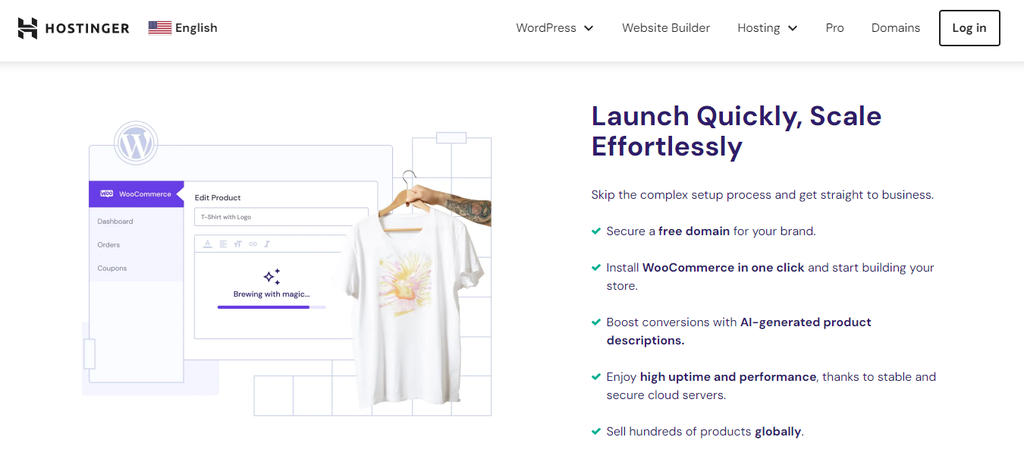
Here are some of the attractive perks included in our WooCommerce hosting plans:
- Free domain registration – give your eCommerce site a professional and branded identity from the start, all while eliminating the initial cost.
- Free SSL certificates – ensure encrypted transactions and boost customer trust.
- Caching tools – improve page load times and provide a better user experience thanks to LiteSpeed Cache for WordPress.
- Complimentary site migration – transfer your eCommerce site with no issues with our professional team’s assistance, free of charge.
Our managed WooCommerce hosting has an easy-to-follow onboarding process. The hPanel control panel simplifies site management, letting you focus on your online business growth.
To support your journey, we offer extensive resources such as Hostinger Tutorials, an extensive knowledge base, and 24/7 live chat assistance.
Designed for different online business sizes, Hostinger stands as a low-risk, high-value hosting provider for store owners choosing WooCommerce as their platform. Starting from $3.99/month, our WooCommerce-optimized servers help ensure an excellent overall user experience.

Website Builder
If you seek simplicity in creating an eCommerce store, a website builder is a game-changer. Its drag-and-drop interface and a wide selection of customizable templates are just some of the perks of using a site builder.

Moreover, website builders often come with integrated eCommerce features such as shopping cart-specific features, online payments, and product catalogs.
These platforms are ideal for entrepreneurs, small businesses, or individuals looking to swiftly launch eCommerce sites without technical hassles. Whether you’re launching an online boutique or a digital product store, a site builder can help you start selling online in no time.
Hostinger offers an online store builder designed for ease of use without compromising on functionality.
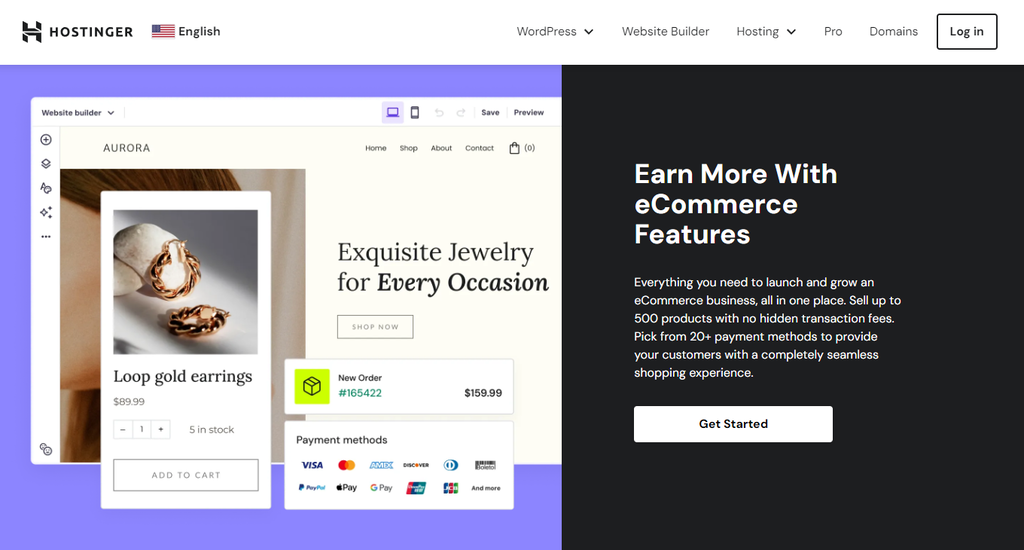
Hostinger Website Builder comes with a full suite of eCommerce-centric features.
In addition to dozens of customizable online store templates, our platform supports up to 500 products and more than 20 payment options. You can also configure shipping options, customize product page designs, and set discounts to attract customers.
To enhance your site’s visibility and search engine rankings, make use of our integrated SEO tools. These tools let you easily edit meta titles and descriptions, implement keyword optimization, and add image alt texts.
Our site builder supports a wide array of third-party integrations. For example, you can install marketing tools, such as Google Analytics or Hotjar, so tracking sales is effortless.
On top of all, we have AI-powered tools to accelerate your eCommerce store setup process.
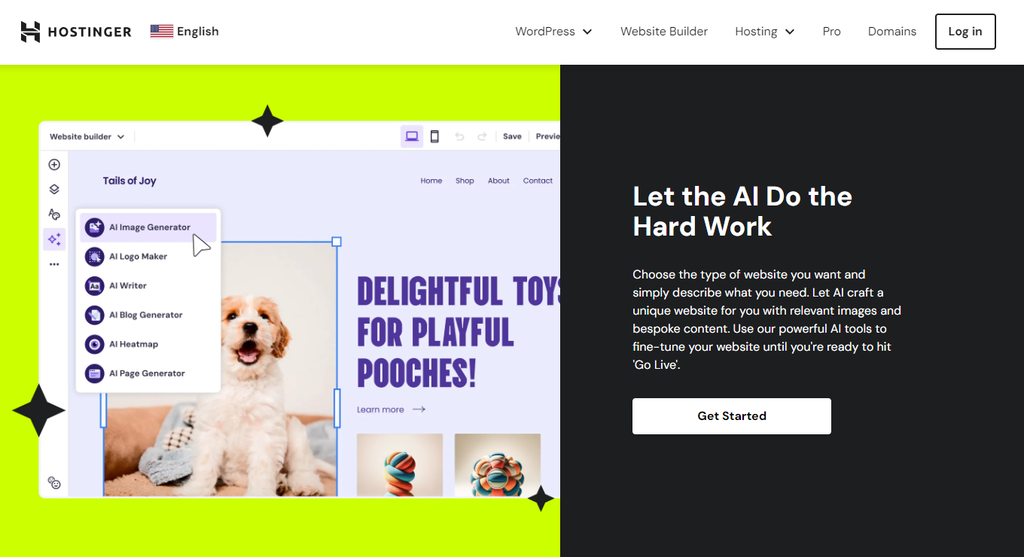
Here are some of our AI tools to take advantage of:
- AI Builder – skip the hassle of choosing from hundreds of templates and let AI set up your website quickly with just your brand name, website type, and a brief description.
- AI Image Generator – create images instantly by entering prompts and selecting a style.
- AI Logo Maker – generate logos in various styles by simply providing your brand name, slogan, and a brief description.
- AI Writer – craft compelling website copy that turns visitors into leads and, finally, customers.
- AI Blog Generator – simplify content creation by providing estimated word count, writing style, and a brief description of the content.
- AI Page Generator – create a new web page instantly by providing a brief description.
- AI Heatmap – forecast user interactions to optimize your call-to-action placement.
At just $3.99/month, Hostinger Website Builder ensures you have all the tools necessary to create and manage a successful eCommerce website.

eCommerce Hosting
eCommerce hosting caters exclusively to online stores’ needs, like processing transactions and managing consumer data. It also goes beyond the standard web hosting service by offering enhanced performance and heightened security that eCommerce stores demand.
The best eCommerce hosting provider should support various popular CMS, such as PrestaShop, and WordPress. These CMS are where you manage your digital content and organize product listings.
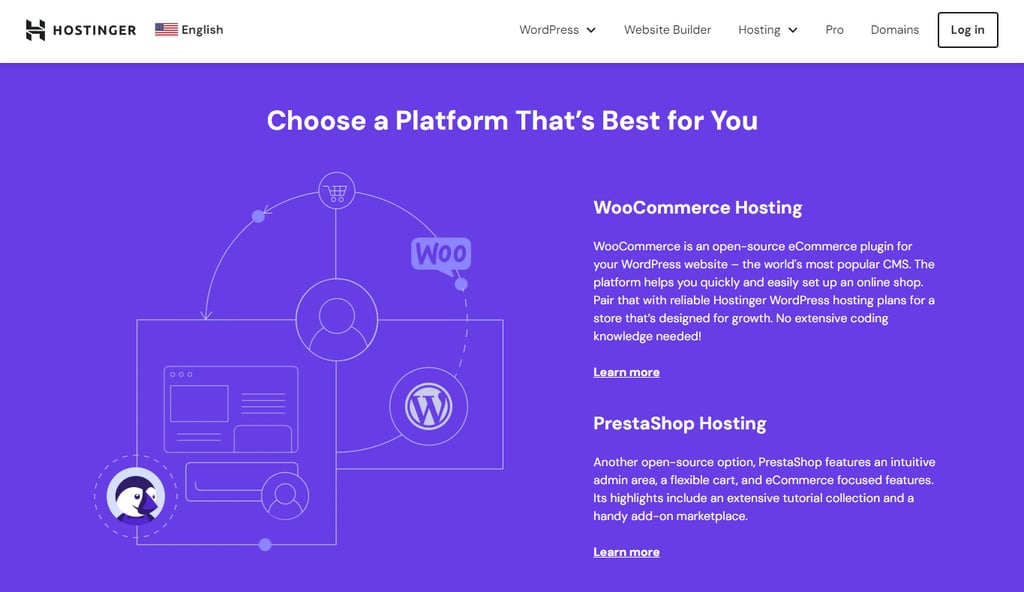
By offering compatibility with your content management system of choice, your hosting provider ensures you have a seamless backend experience.
Now, eCommerce hosting options can encompass a variety of hosting types to suit different website needs and sizes. They also highly influence how much you have to pay for the web hosting service.
Here are different types of eCommerce hosting solutions:
- Shared hosting – allows multiple sites to share the same server and resources. The shared server nature results in lower costs, making it the best hosting option for small business owners just starting out.
- Virtual Private Server (VPS) hosting – divides a physical server into multiple isolated virtual servers. The VPS hosting solution is a good choice for stores that have outgrown their shared hosting plans. Check our comprehensive guide on how shared hosting compares to VPS hosting.
- Cloud hosting – draws resources from interconnected physical servers to create a network of virtual servers for hosting websites. It often uses the pay-as-you-go billing model, which is ideal for eCommerce stores with fluctuating traffic.
- Dedicated server hosting – allows business owners to use an entire server for their eCommerce websites. Offering complete control, excellent performance, and first-rate security, it’s ideal for high-traffic eCommerce sites.
Hostinger’s eCommerce hosting plans are secure, fast, and reliable. Starting from $9.99/month, you can build your small business site using your preferred platform, as well as get free SSL certificates, domain name registration for your first year, and unlimited bandwidth.
With advanced security protocols, integration with leading eCommerce platforms, and scalable options, Hostinger ensures that your online store can deliver an excellent shopping experience.

7 Factors to Consider When Selecting the Best eCommerce Hosting Plan for You
This section will explore seven crucial factors to guide you in choosing the best hosting solution for your business. Let’s get started.
eCommerce Hosting Features
A good eCommerce hosting provider offers a robust set of features to support the day-to-day operations of its clients’ online stores. Key considerations include bandwidth, storage space, and free domain.
Bandwidth
Bandwidth determines the amount of data your website can transfer to your visitors in a given time.
High bandwidth is necessary for eCommerce sites, especially during peak shopping seasons or promotional events. Aside from maintaining fast loading times, it ensures that the increased number of visitors and transactions are accommodated.
To calculate the bandwidth needs for your eCommerce site, consider the following factors:
- Average page size – determine the average size of your web pages in megabytes. Remember, high-quality images and videos can significantly increase page size.
- Average monthly visitors – estimate the number of visitors you expect to receive each month. Consider both regular traffic and potential spikes during promotions or holiday seasons.
- Average page views per visitor – estimate how many pages an average visitor views during their session.
- Redundancy factor – add a redundancy factor to accommodate unexpected traffic spikes. A common approach is to add 50% to your calculated bandwidth.
Required Bandwidth (GB/month)= (Average Page Size (MB)×Average Page Views per Visitor)×Average Monthly Visitors×Redundancy Factor
The good news is that many eCommerce hosting providers, including Hostinger, offer unlimited bandwidth. Therefore, be sure to check with your eCommerce host.
Storage space
The storage space you need depends on the size and number of your website files, including HTML files, images, videos, and databases. Take into account the following when calculating your required storage space:
- Product catalog size – more products mean more pictures and possibly videos, increasing the need for storage.
- Content richness – high-resolution photos and videos provide a better user experience but require more space.
- Data storage – customer data, order histories, and other databases also consume storage.
Finding an eCommerce hosting solution that offers unlimited storage is challenging and can be expensive. For a new eCommerce store, starting with a plan that provides at least 10 GB of storage is advisable. It allows some room for initial growth and content expansion.
Then, monitor your usage regularly and upgrade as needed.
Free Domain Registration
Free domain registration offers more than just cost savings. Here are additional benefits that can pave the way for sustained success:
- Reduced startup expenses – one immediate benefit of free domain registration is cutting upfront costs. For startups and small businesses, saving every penny is crucial, enabling resources for other critical areas like design, development, and marketing.
- Simplified set-up process – free domain registration typically comes as part of a hosting package. This integration also means you can manage your hosting account and domain from a single dashboard, streamlining administrative tasks and website maintenance.
- Professional brand image – having a custom domain, as opposed to a subdomain provided by free web hosting services, enhances credibility. In addition to building brand recognition, it helps you gain audience trust from the outset.
An excellent domain name is memorable and reflective of your brand. Thus, avoid using complex spellings, numbers, and hyphens, as they can negatively complicate things in the future. In addition, using keywords relevant to your business helps ensure recognition of the site’s purpose.
Once you’ve found a domain name that meets these standards, the next step is to check its availability. For this step, utilize a domain name search tool to promptly check if your desired name is available.
Domain Name Checker
Instantly check domain name availability.
Speed and Performance
Your site speed directly impacts user experience and search engine rankings. Some of the hosting elements affecting website speed include:
- High-performance servers – opt for a web host that uses modern, high-speed servers. For example, solid-state drive (SSD) storage significantly outperforms traditional hard disk drives (HDDs) in data access times.
- Server location – the server’s location hosting your eCommerce site can impact load times for your visitors. Choose a web hosting company with data centers close to your target audience to minimize data travel time.
- Caching mechanisms – caching stores copies of your site’s files to serve them faster to your visitors. Look for hosting plans that include built-in caching technologies or support for caching plugins.
Even if your chosen hosting provider checks all the above aspects, further due diligence is necessary.
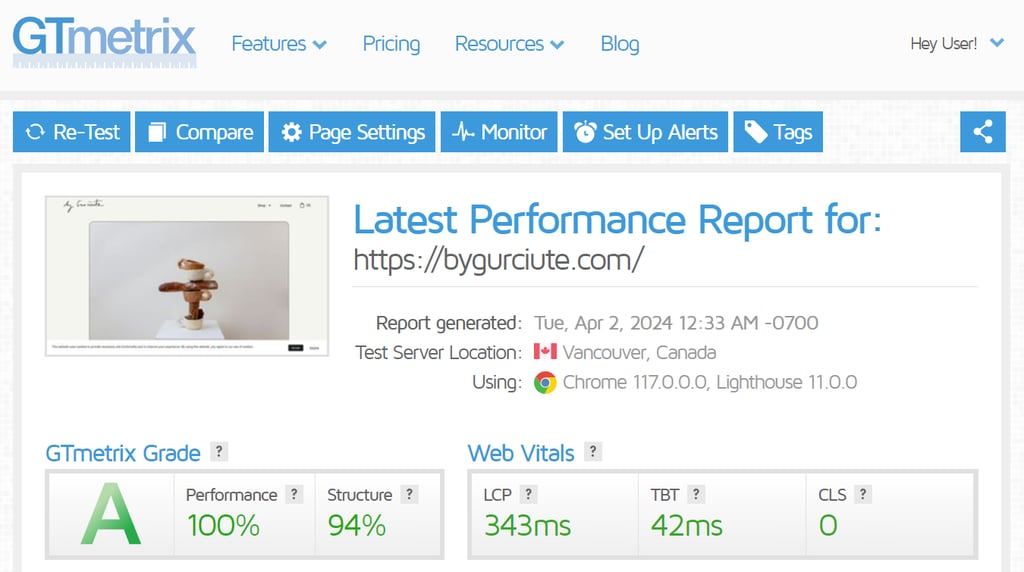
Use available online tools to test the performance of websites currently hosted by the service you’re considering. Tools like GTmetrix and Google PageSpeed Insights can provide insights into site speed and other performance metrics. While you won’t have access to the backend of these sites, seeing how they perform can give you a rough idea of what to expect for your site.
For example, here’s a GTmetrix test report from one of our client’s eCommerce website, By Gurčiūtė:
Technical Support
Running an online store comes with its own set of challenges, and prompt technical support can be invaluable.
First and foremost, your online store operates round the clock. Therefore, your support should too. Ensure the hosting service provides 24/7 technical support to address critical issues that could arise during non-business hours or on weekends, potentially affecting your sales and customer satisfaction.
When it comes to accessibility, good eCommerce hosting providers often have several communication channels, including:
- Live chat – for immediate assistance and quick queries.
- Phone support – offers a direct line for urgent and complex issues.
- Email and/or ticketing system – suitable for less urgent issues where detailed documentation is beneficial
- Social media – increasingly, providers offer support through social media platforms, providing an additional avenue for reaching out.
Customer support specialists should not only be accessible but also knowledgeable. They should have a deep understanding of eCommerce website hosting, be up-to-date with the latest technologies, and possess the ability to solve a wide range of issues.
In addition to assisted client support, you might want to look for a hosting provider offering self-help options. Whether it’s a knowledge base, tutorials page, or community forum, such services help save time for both you and the support team.
Security and Encryption
eCommerce security involves measures to protect websites and online transactions from unauthorized access or disruption. It covers a broad spectrum of practices, from secure data handling and transaction processing to user privacy and data integrity.
Encryption keeps data safe by turning it into a unique code. This means that only people with authorized access can see encrypted information, which often includes customer names, login credentials, and payment details.
SSL certificates are the first line of defense, encrypting data transmitted between your online store and your visitors. An SSL certificate is crucial for protecting sensitive information, and it also contributes to gaining your customers’ trust.
In addition to SSL certificates, here’s an eCommerce security checklist to verify with your hosting provider:
- Firewalls – block unauthorized access.
- DDoS protection – ensures your site remains accessible even during attempted attacks by distributing traffic across a network of servers.
- Regular malware scans – facilitates early detection to prevent damage and promptly neutralizes any threats.
- Proactive monitoring – detects unusual activity patterns, potentially identifying and mitigating new threats before they cause harm.
- Two-factor authentication (2FA) – adds an additional layer of login security, ensuring only authorized users can access sensitive backend functions.
- Secure payment gateways – partnering with reputable payment processors that comply with the Payment Card Industry Data Security Standard (PCI DSS) is essential for a more secure online transaction.
- Data backups – automatic backups can be a lifesaver in the event of data loss, whether from technical failures or cyber-attacks. Ensure your hosting plan includes comprehensive backup solutions that allow for easy data restoration.
Guaranteed Uptime
Uptime, a crucial indicator of your online store’s reliability, reflects the proportion of time your website is operational and accessible to your audience. It’s essential for maintaining customer trust and ensuring consistent sales. Here’s why:
- Customers expect your online store to be available whenever they need it. High uptime guarantees are vital for providing a great online shopping experience, reducing the risk of losing sales and damaging your brand reputation due to website downtime.
- Frequent downtimes can negatively impact your website’s performance on the search engine results page (SERP). As search engines aim to offer the best user experience possible, a site that’s often down may be deemed less reliable.
99.9% uptime guarantee, often referred to as three nines, allows for about 8.76 hours of downtime per year. While it sounds near-perfect, it can be significant for high-traffic eCommerce websites.
This is why more hosting providers offer uptime guarantees of 99.99% or even 99.999%. They translate to less than an hour and just over five minutes of downtime per year, respectively.
Regardless of a web host’s uptime guarantee, it’s crucial to conduct your own verification.
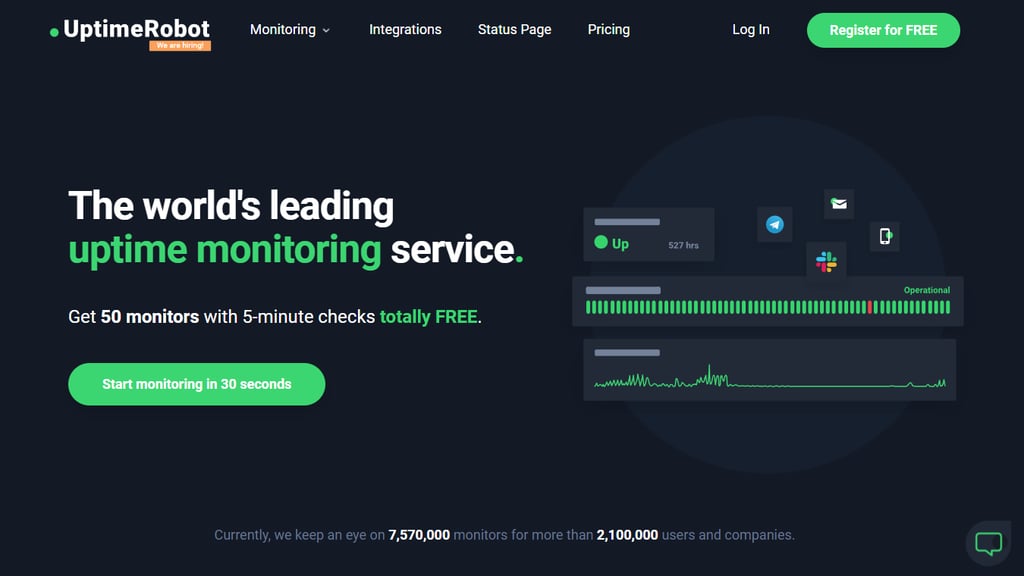
Use third-party tools like UptimeRobot or Site24x7 to check a web host’s uptime. This will help you see whether your chosen eCommerce web hosting provider is meeting their uptime guarantee.
You should also review the provider’s service level agreements (SLAs). This document outlines the uptime guarantee and the compensation you’re entitled to if the service falls short. Compensation might include account credits or other forms of reimbursement.
Hostinger maintains transparency about our server performance through our status page. This dedicated page contains detailed logs and historical uptime data.
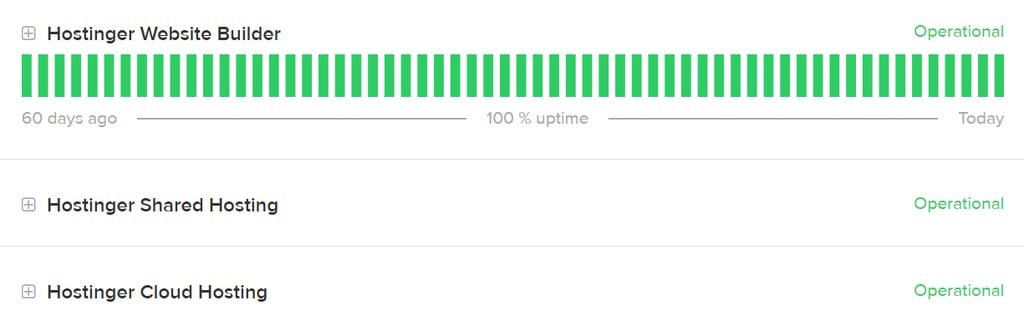
These insights enable our customers to plan better and affirm our commitment to maintaining high service standards.
eCommerce Platform Integration
Hosting providers that integrate seamlessly with top eCommerce platforms such as WooCommerce, Shopify, and Magento can significantly simplify the technical hurdles of starting an online store.
Such integration ensures you can use the necessary features, from product management and payment processing to inventory management and customer analytics, all within a cohesive environment.
When looking for the best eCommerce hosting services for easy integration, consider the following:
- One-click installations – simplifies the initial setup process, allowing you to get your store up quickly.
- Pre-configured solutions – some eCommerce web hosts offer pre-configured, optimized settings for specific eCommerce platforms. These tailored solutions can enhance your store’s performance right from the start.
- Reliable customer support – choose a hosting provider with a strong track record of exceptional support to eCommerce clients. Knowledgeable support staff is invaluable, especially when addressing complex issues.
- Scalability – opt for an eCommerce host offering scalable features, like storage expansion and performance upgrades, to ensure a healthy business’s growth. Therefore, you can expand your store’s capabilities, handle increased traffic, and add new features as it evolves.
Content Delivery Network (CDN) Setup
Incorporating a content delivery network (CDN) is a strategic move for eCommerce websites, especially those serving a global customer base.
A CDN stores your site’s static content, like images and script files, on global servers. When a user visits your eCommerce store, the nearest server delivers data, cutting down page load times by reducing data travel distance.
As a result, integrating a CDN into your eCommerce store brings the following benefits:
- Improved user experience – faster page load times translate to a smoother browsing experience, keeping potential customers engaged and reducing bounce rates.
- Enhanced SEO rankings – search engines favor fast-loading websites. By boosting your site’s speed, a CDN can help improve your site’s search engine rankings, ensuring it’s more visible to potential customers.
- Scalability – CDNs effortlessly handle traffic spikes without compromising your website’s performance, crucial for holiday seasons or flash sales when traffic volumes can surge.
When researching CDNs for your eCommerce site, think about what’s crucial for your business. You can start by reviewing its geographic coverage to make sure the CDN’s servers span the regions where your target customers are.
Security is another important consideration. You’ll want a CDN that not only speeds things up but also keeps your site secure with features like token authentication to protect your eCommerce business and your customers.
Additionally, the ideal CDN should fit seamlessly into your existing setup, requiring little to no adjustments to your website’s infrastructure.
However, it’s not just about fitting in; it’s also about giving you more freedom and control. Look for a CDN that provides comprehensive analytics and flexible settings. This way, you can tailor caching rules to your needs and keep a close eye on how your content is being delivered and consumed.
Hostinger’s CDN, now fully launched after extensive testing on over 10,000 websites, can boost site performance by up to 40% without any need for user configuration. It offers features like:
- Static content caching – stores copies of static website elements, like HTML pages, images, and style sheets, on multiple servers.
- Data center rerouting – redirects your website’s traffic to alternate data centers in case of issues, ensuring continuous uptime and eliminating concerns about potential downtime.
- CSS and JavaScript minification – reduces script file sizes by removing unnecessary characters like spaces and comments without changing their functionality.
- CDN bypass – temporarily skips the CDN use for certain content or in specific situations to ensure visitors access the latest content or for debugging purposes.
- Built-in security – offers various free-included security measures, such as DDoS protection, SSL/TLS encryption, and web application firewalls, to safeguard online stores from various cyber threats.
Upgrade to compatible hosting plans, including managed WooCommerce’s Business and eCommerce’s Cloud Startup, to leverage Hostinger CDN and potentially boost your store’s performance significantly.
Conclusion
Selecting the right eCommerce hosting plan can significantly impact the success of your online store. Let’s have a short recap on the three most common hosting solutions to create an eCommerce store and to whom they’re perfect:
- WooCommerce hosting – ideal for small to medium-sized online stores that seek flexibility in design and functionality.
- Website builder – best suits small business owners with little to no technical expertise and wanting to set up a professional-looking online store quickly.
- eCommerce hosting – perfect for online businesses expecting high traffic volumes and requiring advanced eCommerce features.
We’ve also shared seven factors to help you review various eCommerce plans. By carefully considering those factors, you can choose a hosting solution that meets your specific needs and supports your business’s growth.
Remember, the best eCommerce hosting provider is one that offers a balance of performance, reliability, and scalability. By securing these three aspects, your eCommerce website will be in good shape to provide a seamless shopping experience for your customers.
Good luck with your eCommerce business!
What Hosting Plan Do I Need for eCommerce FAQ
Let’s answer three frequently asked questions about choosing the best eCommerce hosting plan.
What Is the Difference Between an eCommerce Platform and eCommerce Hosting?
eCommerce platforms refer to software that allows you to build and manage an online store. Meanwhile, eCommerce hosting is the service that makes your store accessible on the internet.
Is Shared Hosting Good for eCommerce?
Shared hosting is a cost-effective option for building a small eCommerce site. However, it may not provide the performance and security needed for larger, high-traffic stores.
How Much Hosting Space Do I Need for an eCommerce Website?
For an eCommerce website, start with at least 10 GB of storage to accommodate your product catalog, high-quality images, and customer data. Regularly assess and adjust as your site grows.
All of the tutorial content on this website is subject to Hostinger's rigorous editorial standards and values.


Linda is a seasoned Content Writer specialized in website creation. With her passion for the written world and obsession with helping others, her goal is to deliver resourceful content pieces for all skill levels. When she’s not writing, Linda likes to cross stitch and watch films. Follow her on LinkedIn.

Comments
0 responses