How to build an online course from scratch
Mar 05, 2026
/
Nurul S.
/
19 min Read

Creating an online course involves identifying a profitable topic, structuring a clear curriculum, producing high-quality content, and choosing the right platform to host and sell your course. Key steps include validating market demand, defining learning outcomes, developing engaging multimedia, and setting up a seamless payment system for monetization.
Here’s a step-by-step guide to building a successful online course:
- Pick a profitable topic that matches your expertise and solves a real problem for your audience.
- Validate market demand using tools like Google Trends and keyword research.
- Understand your audience’s pain points to create relevant and impactful content.
- Structure your course with clear learning outcomes and logical progression.
- Choose the best delivery method, whether self-paced lessons, live webinars, or interactive exercises.
- Select a platform that meets your needs for hosting, payments, and student engagement.
- Develop high-quality content with the right tools, such as video editors and quiz creators.
- Price your course based on the value it provides and what your audience is willing to pay.
- Market and sell your course effectively through targeted outreach and social proof.
Download checklist: How to start an online business
1. Pick a topic for your online course
The topic is the foundation of your online course. It should be something you are knowledgeable and passionate about while also solving a real problem for your target audience.
Ask yourself the following questions:
- Where does your expertise lie?
- What topics do people already ask you about?
- Which skills can help others improve their career, business, or daily life?
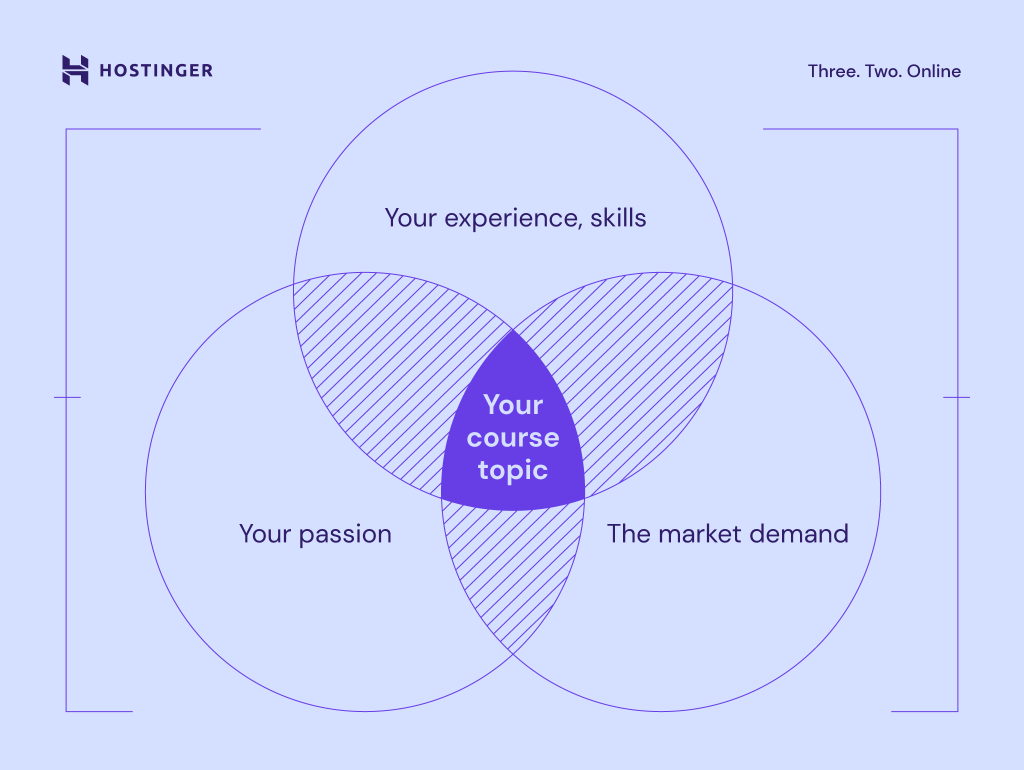
In India, many successful online courses focus on career advancement, exam preparation, and digital skills. Choosing a topic aligned with these needs increases your chances of attracting students.
Popular course topics in India include:
- Digital marketing and social media marketing
- Python programming or coding for beginners
- Stock market trading and investing
- Excel or data analysis for office jobs
- Graphic design and freelancing skills
- Spoken English and communication skills
- Yoga or fitness instructor training
- Government exam preparation such as UPSC, SSC, or banking exams
When evaluating a topic, consider whether people are actively searching for it or discussing it online. A good course topic typically meets three criteria: strong demand, clear learning outcomes, and your personal expertise.
For example, a digital marketing freelancer could create a course on Instagram marketing for small businesses, while a tuition teacher could build an online course focused on math preparation for board exams.
Finding the right topic may take time, but identifying a subject that combines your experience with real learner demand will give your course the strongest foundation.
Expert Tip
I took inspiration for Think In Italian from printed textbooks for the overall learning path, then expanded it to introduce new grammar gradually. I also did some research on other blogs and YouTube channels to see if and how other courses were covering the topics and whether there was a demand on the learners’ side.

2. Test the market demand
Testing market demand ensures that people are actively looking for the topic before you invest time in creating the course. A topic with strong demand is more likely to attract students and generate consistent enrollments.
This includes evaluating the popularity of search queries related to the topic by checking their search volume. To do so, use tools like Google Keyword Planner, Ahrefs, or Google Trends.
To see how often people search for a certain query on Google Trends, simply enter a keyword. It will then display a graph of the keyword’s popularity over a certain period within a specific location.
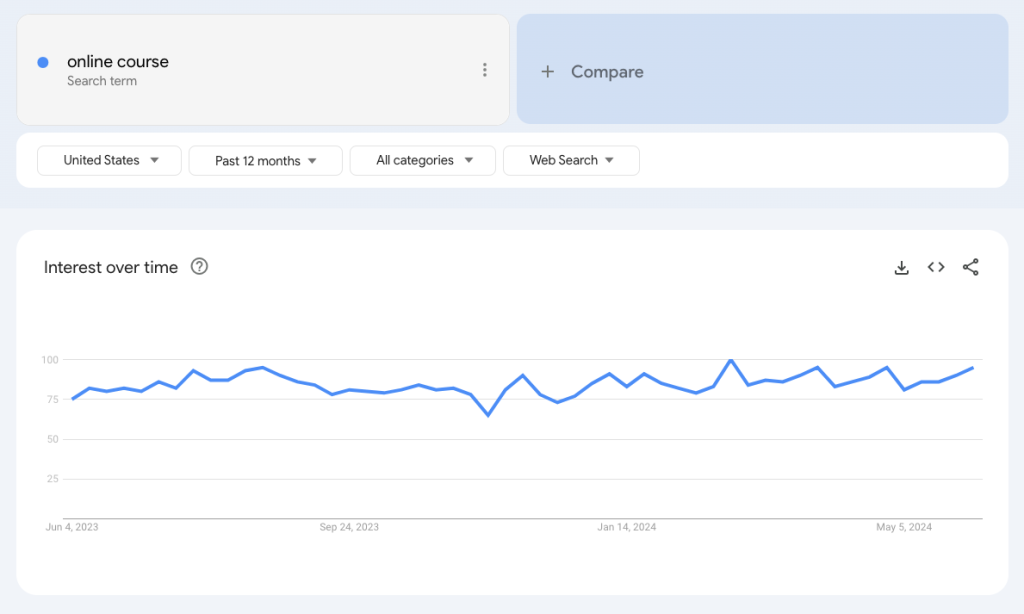
In addition, users can compare two different keywords to see which is more popular.
For example, the digital marketing course keyword has a higher search volume than the queries for social media marketing and google analytics course.

3. Identify and understand your target audience
Your target audience is the people most likely to be interested in your product or service. Identifying this group is a key part of building a brand and developing effective marketing strategies.
This step has two parts: identifying and understanding them by figuring out their pain points.
Define a clear target audience
A defined target audience helps you create the best online course outline and the most effective delivery method. When identifying your target audience, consider these factors:
- Demographic – age, gender, income, education level, and location.
- Geographic – country, state, city, and community.
- Psychographic – interests, values, attitudes, and lifestyles.
- Behavioral – online behavior, purchasing habits, and media consumption.
In India, many online courses attract learners, such as:
- college students building job-ready skills
- working professionals upgrading their careers
- freelancers learning digital skills like graphic design or SEO
- entrepreneurs learning marketing or eCommerce
- school students preparing for competitive exams
For example, a Python course may target engineering students and early-career developers, while a spoken English course may focus on job seekers preparing for interviews.
Figure out the pain points of your potential students
Once you identify your target audience, it’ll be easier to understand their pain points – specific issues encountered by your potential students.
Here are some of the most common pain points:
- Career growth – learners want skills that help them secure better jobs or promotions.
- Financial concerns – students look for affordable courses with clear value.
- Learning accessibility – many learners prefer mobile-friendly lessons they can study at their own pace.
- Practical knowledge – students want real-world examples and job-ready skills rather than theory.
You can identify these pain points by engaging directly with your audience. Run polls on social media, ask questions in online communities, or collect feedback from students if you already teach offline or through YouTube.
Another effective approach is reviewing questions people ask in forums, course reviews, and social media discussions related to your topic. Patterns in these questions often reveal the exact problems learners want to solve.
Understanding your audience’s needs allows you to create course content that directly addresses their challenges, making your online course more relevant and valuable.
4. Structure your online course
Structuring your online course helps organize the material into a clear learning path. A well-structured course makes it easier for students to follow lessons, understand concepts, and complete the program successfully.
This step involves creating a course outline and a storyboard that maps how students will progress from one lesson to the next.
Develop a course outline
The online course outline details the topics and subtopics that will be included in your course. This serves as a roadmap for both you, the course creator, and your students.
Structuring your course outline is important to ensure that your content flows smoothly and logically. It also helps to keep you on track during the creation process and makes it easier for students to follow along with the material.
Here are some tips for creating an effective course outline:
- Start with the end goal – think about what you want your students to get out of this course. What skills or knowledge do you want them to gain?
- Set the timeline – let students know how long the online learning will last and when they can expect to complete each module or lesson.
- Divide your course into sections – break down the course material into manageable chunks.
- Use a consistent format – this applies to the course’s introduction, objectives, content, exercises or activities, and conclusion.
- Include assessments – add quizzes or assignments to measure student understanding and progress.
For instance, a Python programming course might include modules such as:
- Python fundamentals
- Variables and data types
- Working with loops and functions
- Building small projects
- Final coding project
Structuring your course into modules keeps the material organized and prevents students from feeling overwhelmed.
Expert Tip
Developing the courses for Traverse was iterative. For instance, our Mandarin course was designed in collaboration with top-ranked institutions and tested across various proficiency levels, incorporating feedback from users to ensure it addresses real challenges learners face.

Create a storyboard
A storyboard is a visual representation of your online course’s structure, showing the flow from one lesson to the next. It maps out the content and major transitions, much like a movie or video game blueprint.
Using a storyboard is helpful because it helps you visualize the educational journey, showing how different sections connect and interact.
By visually laying out the course, a storyboard can also help identify the best places to incorporate interactive elements, assessments, or multimedia components to enhance engagement.
To create a storyboard:
- List the key topics and learning objectives for each module.
- Define the main takeaway students should gain from every lesson.
- Arrange lessons in a logical order so concepts build on one another.
- Identify places where you can add quizzes, exercises, or demonstrations.
For example, in a digital marketing course, the storyboard might include sections such as SEO basics, social media advertising, and email marketing. Each section builds on the previous one to help students develop a complete marketing strategy.
You can create a storyboard using tools like Canva, Miro, or simple diagrams, or even sketch it on paper. Once the structure is ready, review it and gather feedback from colleagues, students, or peers to ensure the course content is clear and well-organized.
A strong course structure ensures that your lessons follow a logical progression and helps students stay engaged throughout the learning process.
5. Select the most engaging and effective delivery method
Choosing the right delivery method determines how students interact with your course and how effectively they learn the material. Different formats work better depending on the topic, audience, and learning goals.
There is a variety of options for delivering online courses, including:
- Webinars – live or recorded presentations where students can interact through questions and discussions.
- Self-paced modules – structured lessons that students complete on their own schedule.
- Mobile learning – courses optimized for smartphones and tablets.
- Interactive videos – videos with built-in quizzes, exercises, or branching scenarios.
- Gamification – learning elements such as points, badges, or leaderboards that encourage progress.
- Discussion forums – spaces where students can ask questions and interact with other learners.
In India, many students prefer self-paced, mobile-friendly courses because they often learn outside regular working or study hours. Since most learners access courses through smartphones, keeping lessons concise and easy to follow on mobile devices improves completion rates.
Expert Tip
Ling uses gamification techniques, such as points and levels, to incentivize progress. We also incorporate interactive exercises like matching pairs, fill-in-the-blank, and pronunciation practice using voice recognition. Assessments are strategically placed at the end of each unit to gauge comprehension and retention, adapting to the user’s performance.

You can also combine multiple delivery methods to create a more engaging learning experience. For example, a course might include recorded video lessons, quizzes after each module, and a community discussion group where students can ask questions.
Expert Tip
I was coming from years of 1:1 tutoring, so I knew what my students needed – and, more broadly, language learners. People spend most of their study time on grammar and translation but overlook the most important skill – speaking. That’s why I made an audio course that prompts users to speak all the time.
When deciding on a delivery method, consider your course objectives and your students’ learning preferences. For instance, a coding course may benefit from interactive demonstrations and exercises, while a spoken English course may work better with audio practice and live sessions.
If you are unsure which format works best, gather feedback from potential students through surveys or social media polls. Understanding how your audience prefers to learn helps you design a course that keeps them engaged and improves their chances of completing it.
6. Choose your online course platform
The platform you choose to host your online course plays a major role in its success. It affects how students access your content, the tools available for course creation, and how you manage payments, marketing, and student engagement.
There are three main types of course platforms:
Build your own website
Creating your own website offers the highest level of control and customization. You’ll have full control over branding, pricing, and student interactions, which can help you build a strong connection with your audience.
However, managing your own website requires more technical knowledge and can be more time-consuming.
If you choose to go this route, WordPress is a great option for building a website. It offers a range of plugins for creating and selling online courses, including LearnDash, LifterLMS, and MemberPress.
- Pros: Full control, no platform fees, better branding opportunities.
- Cons: Requires technical knowledge, may involve higher setup costs.
Indian Option: Hostinger’s Managed WordPress Hosting is an affordable choice with reliable uptime, fast loading speeds, and easy-to-use plugins, making it an excellent option for course creators.
There are three pricing options: Premium is ₹149.00/month, Business is ₹249.00/month, and Cloud Startup is ₹599.00/month.

Once you’ve selected a plan and created your WordPress account, choose whether you’d like to build a website using Hostinger’s Website Builder or a WordPress theme.
The setup process will encourage you to create content using AI. By typing your brand name and description, the AI will craft original content for your website that you can later edit and customize.
This feature is perfect for those who are new to website building and want to save time and energy when creating engaging content.
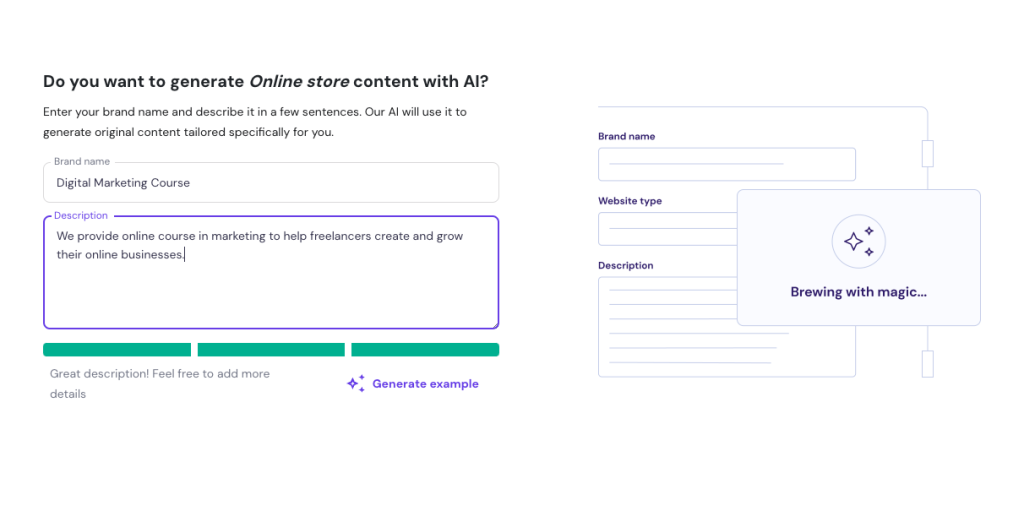
The setup process will finish once you’ve added your custom domain name. After that, you can start building your online course website.
Designing an attractive online course website doesn’t require you to be a web designer. Various free WordPress themes are available to install from its official directory, including Course, BuddyBoss, or WPLMS.
Here are some things to keep in mind when designing your website:
- Make navigation clear and consistent – create a navigation plan based on your course outline. Moreover, provide a table of contents for each module to help students access all course components easier.
- Choose a good color contrast – for better readability, black text on a light background is the safest color combination. Furthermore, avoid adding patterns and images behind the text.
- Pick a readable font style and size – opt for serif or sans serif fonts such as Arial or Times New Roman, as they are easier to read for most people. Ensure the font size is not too small. Ideally, 16 pixels or 12 pt at minimum.
- Check for broken links – links that lead to error pages can discourage students from continuing the learning process.
- Make your site mobile-friendly – doing so can increase the time spent on site, as students can access the course across all devices.
- Design for web accessibility – include audio descriptions and closed captions for videos. Add alt text for charts, illustrations, or photos that are important to the course content.
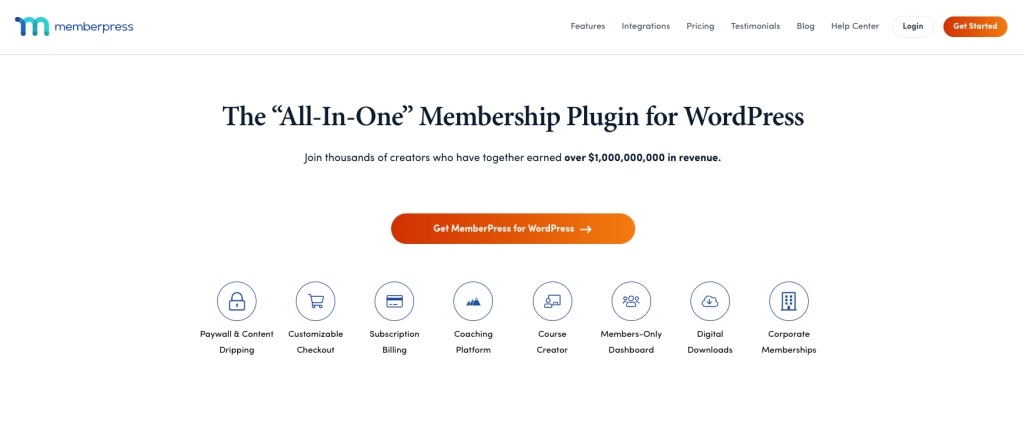
As for WordPress learning management systems (LMS) plugins, we recommend MemberPress. It’s an all-in-one membership plugin with built-in LMS features for creating and selling online courses.
You can also create unlimited membership subscriptions, perfect for managing multiple courses and students.
Expert Tip
My client uses MemberPress because it’s all rolled into one, both Membership and Online course. It has so much functionality, education, gamification, and security – which was perfect for them. It’s a great membership program.

Choose an online course marketplace
An online course marketplace is an excellent solution if you’re just starting out and have a lower budget. Marketplaces provide an easy way to host and sell courses without upfront costs, as you typically only need to pay attention to the instructor revenue share.
Some of the best online course marketplaces include Udemy, SkillShare, Bitdegree, and several Indian platforms such as Easebuzz, Wayvida, and Learnyst. These platforms allow you to reach a wide audience and provide tools to easily create and sell your course.
The table below compares the features and fees of both global and Indian course marketplaces.
| Platform | Best For | Main Features | Pros | Cons |
| Udemy | Versatile course choices | Wide range of courses, lifetime access to purchased courses, certificate completion, individual course purchases | Broad market exposure, set your own course prices, and frequent promotional opportunities | High competition, heavy discounts may reduce earnings, Udemy controls the pricing structure |
| SkillShare | Creative professionals | Subscription-based access, extensive library of creative and business classes, community interaction, project-based learning | Monthly payments based on engagement, strong community for networking, ideal for creative content | Earnings based on minutes watched rather than sales, less predictable income |
| Bitdegree | Tech and blockchain enthusiasts | Focus on technology and coding courses, gamification elements, certificate completion, some courses offer token incentives | Unique niche market, potential for higher engagement through gamification, opportunity to earn with token incentives | Limited audience due to niche focus, newer platform with less established reputation |
| Easebuzz | Indian course creators | Local payment integration, Indian audience focus, simple platform for course creation and sales | Tailored for Indian users, supports local payment methods like UPI and Paytm | Limited global reach, fewer advanced features compared to international platforms |
| Wayvida | Indian course creators | Comprehensive platform for creating, hosting, and selling courses, integrates with Indian payment gateways | Localized for India, easy to use, good for beginners | Smaller platform compared to Udemy or Skillshare, may have limited features |
| Learnyst | Indian course creators | All-in-one platform with course creation, website hosting, and marketing tools, supports local payment integration | Supports Indian languages, mobile-friendly, easy-to-use for Indian educators | Higher subscription cost compared to simpler platforms, some limitations in design flexibility |
When deciding which marketplace to use, consider the type of course you want to offer and the audience you want to reach. Also, evaluate the platform’s marketing tools, revenue share model, and how easily students can discover your course.
For Indian creators, some platforms provide additional advantages such as local payment integrations, support for Indian learners, and mobile-friendly learning experiences. Marketplaces like Easebuzz, Wayvida, and Learnyst are designed with Indian educators in mind and support popular payment methods such as UPI, Paytm, and net banking, making it easier to sell courses to local audiences.
Consider online course creation software
If you prefer an easy-to-use platform that streamlines the course creation, marketing, and sales process, online course creation software can be an excellent choice. These platforms offer an all-in-one solution, providing tools to design and host your course, manage payments, track student progress, and market your content — all from a single dashboard.
Popular course creation software options include Teachable, Thinkific, and Xperiencify. However, for Indian creators, platforms like Learnyst and Graphy are also excellent choices as they offer more localized features for the Indian market, such as support for regional languages and local payment gateways (UPI, Paytm, and net banking).
Here’s a breakdown of some key options:
| Platform | Best For | Main Features | Pricing |
|---|---|---|---|
| Teachable | Independent experts and creators | Customizable courses, integrated payment processing, marketing tools | Free plan, Paid plans from ₹2,100/month |
| Thinkific | Course creators across various industries | Drag-and-drop course builder, membership site integration, full student data ownership | Free plan, Paid plans from ₹2,500/month |
| Xperiencify | Creators focused on gamification | Gamification features, personalized student paths, real-time student notifications | Paid plans starting from ₹4,000/month |
| Learnyst | Indian course creators | Course creation, mobile-friendly design, local payment integrations (UPI, Paytm) | Paid plans starting from ₹3,500/month |
| Graphy | Indian creators and educational institutes | Easy course creation, community-building features, support for Indian payments | Custom pricing |
Compared to marketplaces, course creation software gives you more control over branding, student engagement, and pricing, though it typically involves higher costs than using a marketplace.
When choosing a course creation platform, consider factors like ease of use, local payment integration, mobile-friendliness, and the pricing plans that best suit your goals and budget.
7. Must-have tools for effective content development
Creating high-quality course content requires more than just a great idea — you need the right tools to design and deliver your material in an engaging and professional way. Whether you’re creating videos, PDFs, or interactive exercises, using the best tools can save you time and help your content stand out.
AI content creators
AI-powered tools can be incredibly useful for generating course ideas, creating draft content, and even writing sections of your course material. These tools can significantly speed up the content creation process by assisting with brainstorming, structuring lessons, and ensuring that your material is engaging and well-written.
Many website-building and course-creation platforms now integrate AI content tools into their offerings. For example, Hostinger’s AI Writer is available 24/7 to help you create content whenever you need it, whether it’s for writing course descriptions, blog posts, or even lesson outlines.
Using AI tools like these can save time, enhance content creativity, and help you stay organized as you develop your course materials.
Image editors
Visual appeal can significantly improve your course’s effectiveness. Tools like Canva, Adobe Photoshop, and Pixlr allow you to design eye-catching graphics, thumbnails, and course materials to enhance the student experience.
Canva is particularly popular in India because it offers free templates in multiple Indian languages, allowing you to create visuals tailored to local students.
Video editing software
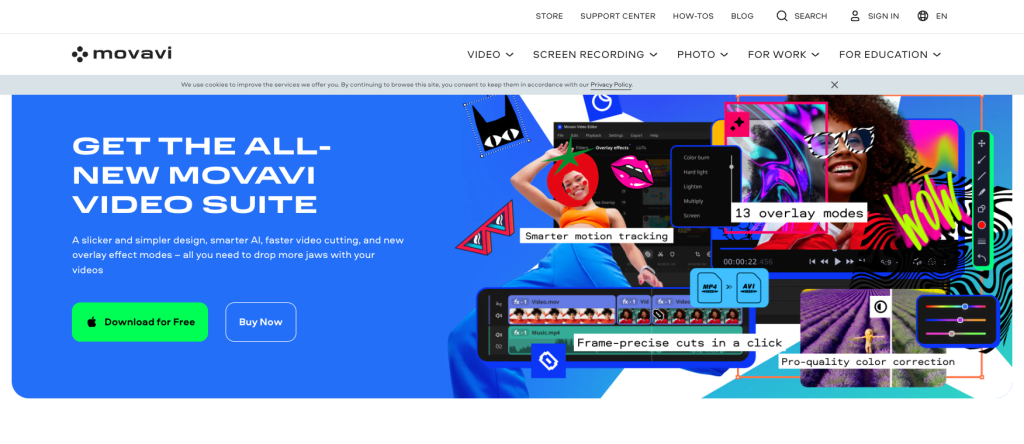
Since video content is often the most effective way to teach, having good video editing software is essential. Tools like FlexClip, Movavi, and Adobe Premiere Pro help you create professional-quality videos without needing advanced technical skills.
For Indian creators, Filmora and Kinemaster are popular, budget-friendly video editing tools that are mobile-friendly, ensuring you can create high-quality videos directly from your phone.
Screen recording software
For courses that require step-by-step tutorials (like software training or coding), screen recording software is crucial. Camtasia, OBS Studio, and Loom are excellent tools for recording your screen and adding voiceover commentary.
These tools are essential for creating software tutorials, demonstrating processes, or explaining concepts with visual aids. Loom is particularly useful for Indian creators because it’s easy to use and works well for quick, on-the-go video creation.
Quiz generators and gamification tools
Interactive elements like quizzes and gamified learning can keep your students engaged and motivated throughout the course. Tools like Kahoot!, Quizlet, and PlayPosit let you create quizzes and interactive videos that reinforce learning.
In India, Quizizz is gaining popularity as a platform that allows educators to create fun, interactive quizzes with regional language support. Gamification tools like Badgr help you add badges, leaderboards, and other motivating elements to your course.
8. Start selling your online course
Selling your online course can help you generate income. In this section, we will discuss the pricing strategies and sales goals.
Set pricing for your course
When deciding how much to charge for your course, consider factors such as content quality, the value it provides, and the target audience’s willingness to pay. In India, pricing is sensitive, so it’s essential to strike the right balance between affordability and quality.
- One-Time Payment: This is a straightforward option where students pay once for lifetime access to your course. Typically, this model is used for courses with evergreen content (i.e., content that doesn’t require frequent updates). For beginner courses, this could range from ₹999–₹5,000, while more advanced courses can go up to ₹10,000 or more.
- Subscription: Charge students a recurring fee for ongoing access to new content, updates, or additional features. This model works well for courses with regularly updated material (e.g., digital marketing or tech courses). Monthly fees range from ₹300 to ₹1,500, depending on the course’s complexity.
- Freemium Model: Offer a basic version of the course for free and charge for premium content. This works well for building trust and attracting students who are hesitant about paying upfront. The premium version can range from ₹2,000 to ₹15,000 based on the depth of the content.
Expert Tip
We’ve adopted a freemium model for Ling, which has been effective. It allows users to access a number of courses and features for free, while premium features are unlocked through a subscription. This strategy helps prospective users see the value in Ling before making a purchase decision.
Set sales goals
When selling online courses, it’s important to establish clear and measurable sales goals. These goals provide targets and benchmarks that help guide your marketing and sales strategies.
Start by setting realistic targets based on factors like your audience size, market demand, and previous sales performance, adjusting them as your business grows.
Review your sales data regularly to see what’s working and what needs adjustment. This analysis is important for fine-tuning your strategies to meet your audience’s needs better.
For example, if a course isn’t selling well, consider revising your marketing approach, updating the course content, or adjusting the price.
The regular sales review allows you to track progress, make informed decisions, and ultimately achieve your sales targets.
9. Start building your client base
Building a client base is about developing a network of loyal students who are engaged and interested in your course. A strong client base is more than just a source of income; it becomes a dynamic sales funnel for your business. It sustains current operations and fuels the growth of your future courses.
In India, where word of mouth and referrals are powerful, cultivating a dedicated group of students can help expand your reach and build a community around your courses.
By focusing on client satisfaction and engagement, you lay the groundwork for ongoing course development, marketing, and revenue generation. Here are several strategies to build your client base effectively:
Offer a demo, free trial, or sneak peek
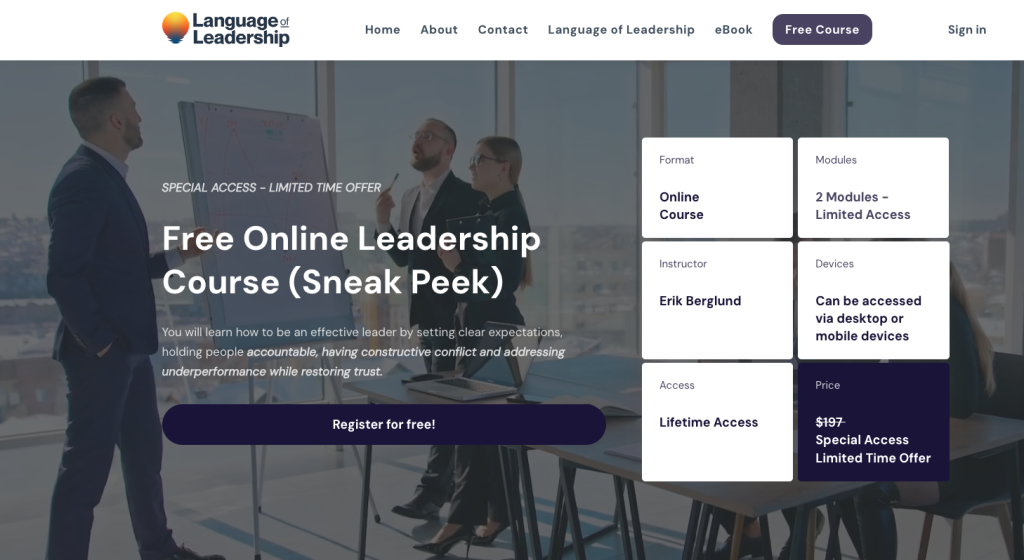
Providing potential students with a preview of your course can significantly increase conversions. Offering a free trial or a sneak peek of your course content lets learners experience the quality and value of your material before committing to a purchase.
In India, where price sensitivity is high, this is especially effective in attracting first-time buyers who may hesitate before paying for a full course. You can offer a:
- Free trial module
- Short introductory video
- Live webinar or workshop showcasing your teaching style and key content
This approach builds trust and increases the likelihood of enrollment.
For inspiration, consider how successful Indian EdTech platforms like Unacademy or Byju’s offer demo lessons, interactive content, or live sessions to attract students.
Pre-sell the course
Pre-selling your course is like pre-ordering a product: it generates interest before the course is fully launched and helps secure early revenue. This is especially helpful if you need funds to improve the course material before the official launch.
In India, pre-selling can be particularly effective because of the strong sense of community. You can create a sense of urgency by offering:
- Early-bird discounts
- A limited number of discounted spots
- Exclusive access to additional content
Promote your pre-sale through social media, email marketing, and WhatsApp groups to create buzz. You can set up a landing page where potential students can learn about the course benefits, the launch date, and the early-bird offers.
Once the pre-sale is over, ensure the course is delivered on time and with high-quality content to meet students’ expectations.
Provide certificates
Providing certificates can significantly increase your course’s appeal. In India, many learners value certifications as they help with career advancement or job hunting. Offering a certificate of completion or a digital badge can incentivize students to finish the course and provide tangible recognition for their effort.
You can create certificates using Canva, Adobe Spark, or any similar tool, with custom designs that reflect the professionalism of your course. For Indian students, a certificate in regional languages or English can be a valuable addition.
Leverage social proof
Social proof, such as testimonials, reviews, and student success stories, is an effective way to build trust with potential students. Encourage your existing students to share their experiences with your course. Word of mouth and positive reviews can boost credibility and attract new students considering enrollment.
You can showcase testimonials on your course landing page, on social media, or in video testimonials. In India, local testimonials in regional languages can make a greater impact and resonate more deeply with potential learners.
For example, Khan Academy India or Skillshare often feature real stories of learners to highlight how the courses benefited them.
Engage on social media
Social media platforms are a powerful tool for building a community around your course. In India, platforms like Instagram, Facebook, LinkedIn, and YouTube are widely used for educational content and community engagement.
Here’s how to effectively engage with your followers:
- Create value-driven content such as tips, Q&A sessions, or industry updates.
- Host live sessions or interactive Q&As where students can ask questions and interact with you in real time.
- Post success stories or student testimonials to demonstrate the impact of your course.
- Join relevant communities or forums on platforms like Facebook Groups or Reddit India, where potential learners gather to discuss topics related to your course.
In India, WhatsApp groups are also a key tool for sharing updates and fostering close-knit communities.
Offer a referral program
Once you’ve established a client base, leverage it to attract more students. Offering a referral program encourages existing students to share your course with their friends, family, and peers in exchange for rewards, such as discounts on future courses or exclusive content.
This approach works especially well in India, where personal networks play a major role in decision-making. Students are more likely to trust recommendations from friends or family.
What are some tips to make your online course stand out?
To ensure your online course captures attention and delivers value, consider implementing these five additional tips to make your course truly stand out.
1. Test your course before the launch
Before you go live, it’s crucial to test your course rigorously to ensure a smooth user experience, especially in India, where internet speed and device compatibility can vary widely.
- Platform Testing: If you’re using a platform like Learnyst or Graphy, ensure that the user experience is optimized for mobile devices and low-bandwidth connections, which are common in India.
- Gather feedback: Involve friends, family, and industry colleagues, particularly Indian students, to understand how well the course materials resonate.
2. Offer a money-back guarantee
Offering a money-back guarantee can be a strong selling point, as Indian students tend to be cautious about online purchases, especially if they are new to digital courses. A clear refund policy can significantly build trust and increase conversions.
- Set clear limits: For example, offer a refund within 7 to 14 days of purchase. Make sure the process is easy and hassle-free.
- Partial refunds: Consider offering partial refunds when the student has consumed part of the course, to avoid losses while still ensuring fairness.
- Highlight the refund policy clearly on your landing pages and in your marketing materials to provide reassurance.
3. Use analytics to improve
Tracking the success of your course is crucial to continuous improvement. In India, students often prefer self-paced courses, so analyzing completion rates, time spent, and student feedback can help you refine your material to better cater to the local audience.
- Use local analytics tools such as Zoho Analytics or Freshdesk to track student interactions and engagement.
- Monitor completion rates and student satisfaction ratings to identify which sections of the course are most engaging and which need improvement.
Additionally, many course platforms provide built-in analytics tools that are simple to use and offer insights into learner behavior.
4. Join competitor courses
Attending competitor courses can help you understand how other course creators structure their content, teaching methods, and pricing models. Analyzing successful courses will help you identify market gaps that align with learners’ needs.
Pay attention to how competitors price their courses, especially in Indian rupees (INR). Indian students are often highly price-conscious, and competitive pricing can significantly impact course enrollment.
Use platforms like Udemy, Skillshare, or Indian platforms like Easebuzz and Learnyst to review top-rated courses in your niche.
5. Offer supplementary material
Offering additional materials like ebooks, templates, checklists, and cheat sheets can increase the perceived value of your course and justify a higher price point.
In India, learners appreciate extra resources that help them apply the knowledge practically:
- Consider creating PDF summaries or study notes in Hindi or other regional languages to broaden appeal.
- Collaborate with local creators to add value to your course by offering cross-promotions or bundled deals.
Additionally, students love discounted bundles or group packages, which can boost course sales and engagement.
Transform your knowledge into a profitable online course
Creating an online course involves several key steps, from choosing the right course topic and validating market demand to structuring lessons, selecting a course platform, and developing engaging learning materials.
Once your course content is ready, the next stage is launching and selling your course by setting the right pricing strategy, promoting it through social media or email marketing, and building a loyal student community. These elements help transform a simple course idea into a sustainable online education business.
Whether you host your course on your own website or use an online course marketplace, focusing on student experience, clear learning outcomes, and consistent improvement will help your course stand out and attract more learners.
With the right planning, tools, and strategy, creating an online course can become a valuable way to share knowledge, grow an audience, and generate long-term income online.


All of the tutorial content on this website is subject to Hostinger's rigorous editorial standards and values.

Nurul Siregar has over 3+ years of experience in the tech industry with a passion for writing about digital marketing. Nurul enjoys reading fiction novels and making digital illustration in her free time. Follow her on LinkedIn.


